
As part of our commitment to sharing the work of graduate students and early-career researchers, one episode a month of Passing Notes will highlight the work of one of these scholars working in the history of education.
Today’s episode is a conversation with Rachel Rosenberg about her dissertation research, which examines the policy of gender and sexuality of American public school teachers in the twentieth century. Rachel is a PhD candidate in history at Yale University, where she studies women and gender, political and education history. Before returning to graduate school, she worked for two years as a middle school teacher in Dallas, Texas.
Episode Transcript
Michael Donnay
This season of the podcast is about highlighting connections between the history of education and other historical approaches or disciplines. But we also want to highlight the work of graduate students and early career researchers working in the history of education. As part of that commitment, we’ll be releasing a short episode about once a month, where we talk with grad students or early career researchers about their research and how it connects the theme from that month’s full length episode.
Today’s guest is Rachel Rosenberg. Rachel is a PhD candidate at Yale University and a historian of the 20th century United States. Her research focuses on the intersection of gender, political, and education history, and her dissertation examines the policing of gender and sexuality of American public school teachers. I was lucky enough to hear Rachel at the History of Education conference in San Diego, and today we’re going to be talking about some of the research she presented there. In particular, we’re going to look at several “crises of masculinity” in the American teaching force from the 1950s through the 1970s. I think Rachel’s research is a great example of how we can illuminate broader issues of class, gender, sexuality, and politics by taking schools seriously as a subject of historical inquiry. I had a great time speaking with her about her research, and I hope you enjoy our conversation.
Welcome to the podcast, Rachel, we’re so excited to have you here.
Rachel Rosenberg
Hi, Michael, thanks so much.
Michael Donnay
Maybe a good place to start is getting an overview of your research. Can you give us a quick introduction to your topic?
Rachel Rosenberg
Of course. So my dissertation more broadly, is on the gender and sexuality policing of public school teachers in the 20th century in the United States. Really, what I wanted to look at was the way that policymakers and education folks were trying to control and limit the gender and sexuality representation of public school teachers. And particularly the way that they were using rhetoric about children – what was best for children, shaping children, protecting children – in order to do that. And there really is a gendered tendency to think of teachers in the United States as women. And one of the things that I started out this project doing was tracking through why that is and how we explain that through the course of the 20th century. And then also thinking about the race and class implications in that gender and sexuality lens.
Michael Donnay
One of the specific areas you focus on is a period from the 1950s to the 1970s. And in this period, you identify what we might call a series of moral panics about masculinity in the teaching profession. Could you explain why you think these panics appear during this period?
Rachel Rosenberg
So I think the 1950s, and certainly 1960s and 1970s, you have a bit of a social political crisis broadly in the United States. Certainly in the sense that there’s a lot of social change and political change that’s happening. So in the United States, this is the era of the civil rights movement. It’s the rise of second wave feminism, it’s gay rights. It’s the Cold War, and certainly going into the Vietnam War era, and anti war protests. So there’s just a lot of social questions that are being asked, that are being debated, that are being protested in the United States. And then into that in the schools. Specifically, we throw desegregation orders, starting with Brown v. Board in 1954, but really taking off under court orders in the 1960s and 1970s throughout the United States. And all of that broader political and social conversation, are really playing out in debates about the classroom. In debates about what children need, and particularly what the gender, race and sexuality identities of teachers should be in order to create and shape the sorts of children that certain policymakers want to see America’s future based on.
Michael Donnay
And what are the specific concerns about getting more men into the classroom?
Rachel Rosenberg
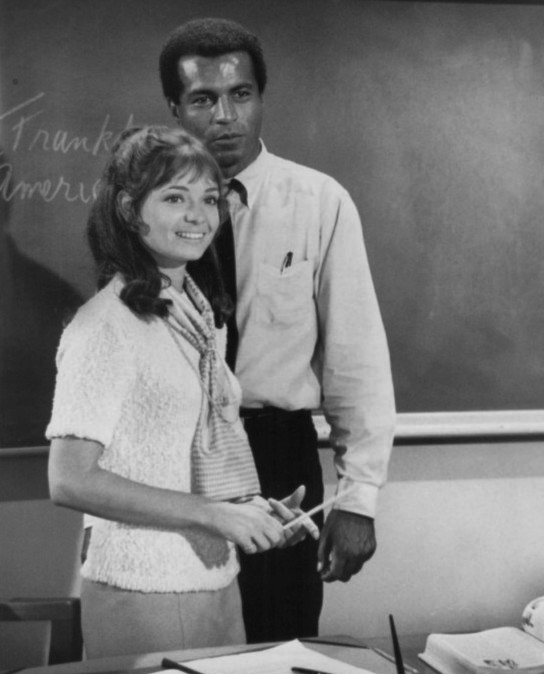
The vast majority of American teachers have been women throughout the course of the 20th century, and certainly in the current moment, as well. But there’s a set of concerns raised in the 1950s, into the 1960s and 1970s, that there really is a push to bring more men, and particularly white men, into the classroom. And there’s a range of reasons for that. Some of it is a fear of over feminization. The idea that too many women are ruining boys or pushing out boys who were too masculine or too rough. You know “too masculine or rough” and that that’s bad for American society. There’s the idea – there just need to be more male roles models for children to have. This is an era where you’re seeing the rise of suburbs. And so you have more men who are commuting into the city, so fathers aren’t home as much. There’s a rise in divorce rates. There’s a racist and classist concern about the nuclear family and what it means for boys not to have men in the home. And then there’s the reality of desegregation. And the idea that white men being in the classroom are going to be able to protect white children, white female teachers from black boys in a very specific and very racist – dealing with discipline – type of ways.
Michael Donnay
It might be helpful to get a sense of what is actually going on in the classroom, which might help put these concerns into more context. My sense is that the teaching force is still overwhelmingly female at this point, is that the case?
Rachel Rosenberg
It certainly is true that there are more women teachers than men teachers, that’s true throughout the 20th century. But that’s actually less true in this period than it is in other points of the 20th century. So the high point in about 1920, 80%, of America’s public teaching force is female. But in 1970, over a third of teachers are men, and actually just over half of secondary teachers are men. And there’s actually a doubling from 1945 to 1970. So in 1945, only about 15% of teachers are men up until over 30% in 1970. So there’s an increase in white men that’s happening in the classroom, absolutely during this period, that’s not matching with this panic about needing more men needing more men needing more men.
That being said, there’s probably not an unreasonable argument that 33% of teachers may not be enough men in the classroom. Right? We have a couple of different pieces to the argument for why it’s good for children to have male role models. Some of them are deeply sexist or deeply racist or deeply classist. But some of them have to do with representation and identity. Some of it has to do with a feminist argument that you need more men in the classroom, particularly in the primary grades, so that children can learn that caring for children is not something that is a woman’s job, or female oriented. That both men and women are educators should care about children can be helpful and thoughtful and kind.
And those are arguments that we see to this day in a slightly different guise about questions about representation in the classroom. And there’s a lot of good evidence that it is helpful for students to be able to see themselves in their teachers, whether that’s gender or sexuality, or race or class, or any number of identity points. So there is this interesting piece that suggests that it’s not entirely irrational to want more gender parity in the teaching force. What is irrational is the degree to which there’s fears over what it means to not have those men in the classroom. The rhetoric around why those men are needed. And just the disconnect between saying there’s so few men and the increase in men in this period.
Michael Donnay
You’ve alluded to it, but it seems like these conversations were about getting a very specific type of men into the classroom. Can you expand on that a little bit? What did the ideal male teacher look like? And how explicitly were those characteristics being discussed at the time?
Rachel Rosenberg
In a little bit of a too long answer, there’s three pieces to the answer of what sorts of men are actually being asked for. One is this idea of a very traditional in some ways – fighting on the playground type of masculinity. So there’s an argument that too many women are over feminizing boys, and that even the men who are going into teaching are feminized in a certain way. They’re not manly men, and that you really need men who are – if not violent, at least presenting a certain type of active of manliness that is different from what is typical of the behaviors that are generally seen to be encouraged in the classroom. So there’s an argument that you just need “manly men” to show boys that that’s okay. To protect boys who are being pushed out of schools for not listening well enough, not sitting well enough, being too rough in the playground, whatever it is.
There’s absolutely a race piece to all of this. So at the same time, that there’s this major push for more white men, the push for men is really a push for white men in the classroom, there’s a very intentional purging of black men from public schools. So part of what we see with desegregation in the United States is as court orders start to force desegregation, desegregation is forced for students, but not for teachers. And so throughout much of the South, which is where the majority of black teachers are in the United States in this period, there’s really just a purging on any number of excuses of black teachers and particularly black men from the classroom. And there are these sometimes hinted implicitly, sometimes rather explicitly, statements about the threat of miscegenation, the idea that these black men are a threat to white women in schools, and particularly to white girls who could be in their classrooms. And there’s a long history in the United States of white supremacist arguments about threatening black male sexuality, a history of lynching, and there’s very much a white supremacist racial coding argument to all of this.
But there’s additionally an interesting piece about student-teacher sex itself, related to but somewhat disconnected from the racism implied in these conversations. Which is that students and teachers have been having sex in the United States for a long time, and certainly throughout the 20th century. And it’s not uncommon in the first half of the 20th century, and not necessarily frowned upon – but that gets a little bit complicated in both the white and black communities – for students and teachers to get married and to have sexual relationships. And so there is this hinting about black male teachers as predators, which is absolutely racist. But it’s also picking up on a very real history of sexual relationships between teachers and students, as an excuse, as one of the excuses to eliminate black men from the classroom and from schools more broadly.
Michael Donnay
Is there a specific example from your research that could help illuminate how this discourse actually operated in practice?
Rachel Rosenberg
Yeah, absolutely. So certainly, I just want to note that there’s absolutely all sorts of other levels of racism involved in purging black men from the classroom. Whites need very few excuses to do so at the time. But there is a piece of it that is explicitly referencing this idea of sexuality or the threat of black sexuality. And so I think an interesting one comes from: there’s a Massachusetts based newspaper founded in the mid 1960s, The Bay State Banner. That [is a paper] for black Bostonians and those who are interested in the civil rights fight. And in 1972, they write in an article, “there’s an organized effort in Mississippi and Alabama to eliminate black males from public schools. Flyers circulated in those states encourage women to snare black teachers, principals, and students or custodians in bogus compromising situations. A reward of $500 is offered for every person expelled or fired.” (Ernest Swain, Bay State Banner, 27 April 1972)
I don’t actually know if those flyers exist, I’ve never found them. If anyone who’s listening to this knows of them, please do let me know I’d really be interested in seeing them if they’re real. But I think the point stands, whether or not they exist, that there is this clear idea of sexuality is a threat, and a clear idea that it’s bogus as well. The quote is literally bogus compromising situations, but talking about black teachers, principals, students or custodians. So there is this idea of using the perceived threat, the created fear of black sexuality, as a way of – as an excuse for – getting rid of black men across the board, teachers included, but other black men as well, in trying to preserve schools as white spaces.
Michael Donnay
This season of the podcast is looking at how other perspectives can inform the history of education. And as we’ve talked today, it’s really clear how your focus on both race and gender has informed your dissertation research. Can you talk about the role you see those approaches playing in your broader intellectual practice?
Rachel Rosenberg
I’m absolutely a historian. I’m in my methodologies, in the way I write, and the way I think, the way I use evidence. And I think that probably comes across in my work and how I speak. But of course, it’s incredibly useful and important to think about other lenses and other disciplines in in how we do our work and our research. And I think for me, one of the things that I find interesting and important to try to explain is the fact that in the United States, we’re back to close to 80% of American public school teachers being women. That’s where we were in 1920 and it’s about where we were in 2020. We narrowed that divide for a little while mid-century, though not according to many of the commentators as we’ve discussed. But we’re back to teaching being an incredibly feminized profession in the United States. And I think that that’s something that we have to take on and think about. And try to explain in ways that we both have and happened.
So much of writing about teachers drops out gender as a lens of analysis after the 1960s and 1970s, after second wave feminism after the other professions open up more broadly to women. In many ways, teaching stops being written about as a woman’s profession, as a female profession, but numerically absolutely stays that way. And there’s so many reasons for that we can talk about ideas about child caring, and effective labor. We can talk about pay and low pay. There’s lots of pieces to that. But I think to me, it was really important to keep gender, as well as sexuality, as well as race, as well as class, and all of these other lenses through the 20th century. Because I think that we have to do that in order to continue to understand why it is that teaching continues to be so heavily female dominated in this country. And what the implications of that are for our education system broadly, but also for our students, more specifically.
One of the things that I tried to do with my work as a historian, but as a historian who was a public school teacher, and who takes P-12 schools incredibly seriously, is to continue to push this idea that we can use schools as a place to answer so many other questions about history. And so I’m a history of education person, but I’m also an American gender and sexuality history person. I’m a women’s historian. I’m a 20th century US social and political historian. And I think that my big claim, or one of them, is that we absolutely can see so many issues that so many other important scholars look at being fought over and negotiated through the lens of the classroom. And that if we take school seriously, if we take the debates over school seriously, if we take the rhetoric of protecting children – whether or not we think that it’s real or imagined rhetoric – if we take that rhetoric seriously, we can see so many other issues that are not just education based, being fought out in classrooms, and I think that we can learn a lot from that.
Michael Donnay
Thank you so much for joining me today, Rachel. I really appreciate you sharing your research with us.
Rachel Rosenberg
Yeah, thanks, Michael. This has been a lot of fun and I really appreciate you taking the time.