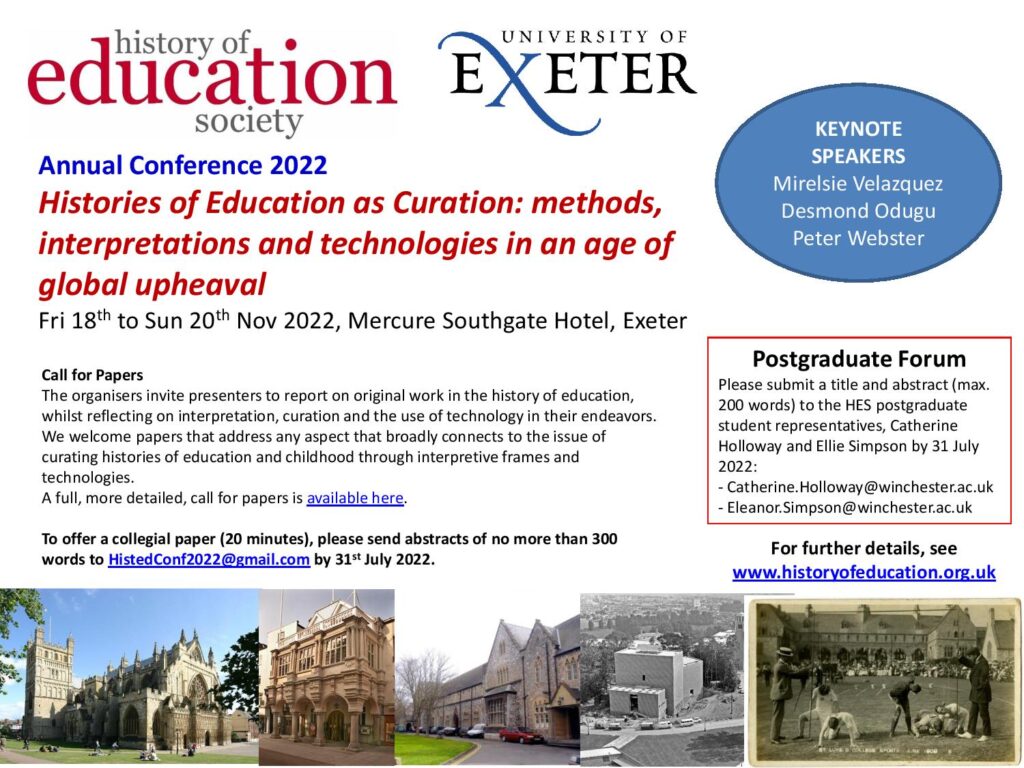
History of Education (UK) Annual Conference 2022
Mercure Southgate Hotel, Exeter, Devon, Friday Nov 18th to Sun Nov 20th 2022
Histories of Education as Curation: Methods, Interpretations and Technologies in an Age of Global Upheaval
The practice of history has always been influenced by the perspectives that researchers and scholars bring to their work. However, the early twenty-first century is witnessing major developments through which such perspectives are being channelled and perhaps reshaped. Digital technologies are reorganising the ways in which scholars access historical sources – written, oral and visual. When taking digital form, these sources can be both analysed in new ways (such as quantification of qualitative sources in the ‘digital humanities’) and disseminated to ever larger audiences (including interactively). Accompanying all this in polities such as Britain is an increasing onus on individual scholars in the humanities actively to curate not just their research projects and publications, but themselves as freestanding or collaborative intellectual producers.
However, the story is not simply that of histories of education being shaped ‘from the outside’. Digital technologies have been embraced by many scholars in the field as integral to their historical practice. Our professional activities are being reorganised through databases, online conferences and webinars that link more intensively an already globally connected research community. We are able to make pre-existing sources accessible in new ways and to much larger audiences. And we can create and fashion new, born-digital historical resources, such as recordings (sound and film), machine readable text and objects scanned in 3D, placed and interpreted in virtual galleries.
This conference will draw on such broad contexts to characterise its delegates and presenters as “curators” of the history of education, in a period of growing cultural, economic and environmental upheaval in all regions of the world. As curators, we do not merely practice and preserve history. We also mediate it through the perspectives which frame our work, the ways in which we access and deploy our sources and the interpretive weight we ask these sources to bear. This mediation extends to the technologies we use, the networks in which we participate and the methods of dissemination we favour (closed and/or open access; professional readerships and/or ‘public’ histories; knowledge generation and/or research ‘impact’; and so on). Perhaps most fundamentally, these developing conditions when viewed as a whole prompt new questions as to why present-day histories of education are undertaken at all, how their purposes might be changing and the forms they might take in future.
To what extent, then, is active ‘curation’ a central task of the historian of education? Is it best seen as a by-product of our principal role as researchers and knowledge creators? How are the perspectives and epistemological frames we bring to our work shaped (wittingly or unwittingly) by the kinds of curation we practice? Is it appropriate to speak of the ‘duties’ of the historian of education and include among these the considered curation of the work we produce? And, if so, can and should one object of such curation be contributions designed to help resolve – or, at the least, contextualise – today’s major global upheavals?
All these questions have prompted the present call for papers.
Call for Papers
The conference organisers invite presenters to report original work in the history of education, while also reflecting on interpretation, curation and the use of technologies in their endeavours.
The following is an indicative list of themes that authors are invited to consider when presenting their work at the conference. It is far from being exhaustive or prescriptive and we welcome papers that address any aspect that broadly connects to issues of curating histories of education and childhood through interpretive frames and technologies:
(a) how our histories of education are influenced by perspectives and interpretive frames such as:
- the spatial: the staking out of local, national, regional and global geographies and narratives
- the temporal: how we understand time in our research projects
- exogenous dimensions: research into episodes in education strongly influenced by, or experienced as, ‘external’ imposition
- Indigenous / endogenous dimensions: studies of education reflective of situated cultures
- socio-political perspectives: historical studies informed by ideologies, movements and causes
- present-mindedness: histories of education which are influenced (implicitly or explicitly) by:
- present-day outlooks on the wider world
- contemporary activism / activist movements
- implications for twenty-first century theory and practice in education
- education, local cultures and geopolitics: histories of education in the context of global sustainability and individual agency
- histories of education and globalising tensions: interfaces of social justice, marginalised voices, and the ways of the prosperous and of elites
(b) how our histories of education are ‘curated’ – through technologies of various kinds, among audiences of different types and in the context of global upheaval:
- digital archives: problems and possibilities
- access to visual, oral and written sources: silences and absences
- curation/creation of born-digital visual, oral and written sources: a rebalancing or new distortions?
- digital, print and other forms of dissemination: reach? inclusion? impact?
- serving specialised and wider readerships: what is ‘arcane’ and what is ‘accessible’?
- format in histories of education: is orthodoxy suffocating experimentation?
- recovery of the past and/or influence over the present/future: volition in the history of education
- historiography in an interconnected world:
- a homogenising culture of practice or encouragement of variety?
- local, regional and global developments: the faltering grip of the Western episteme?
Submission Procedure
Please submit abstracts of no more than 300 words to [email protected] by 31 July 2022.
In drafting the abstract of your proposed conference presentation, please indicate how your contribution will include reflections on at least one of the areas from either section (a) or section (b), above. Contributions which address one or more areas from both sections (a) and (b) would be especially welcome.