
Elena Rossi, Magdalen College, Oxford
Ever fallen asleep in a boring class? Had a lecturer that always let their classes overrun? What if you could fine your lecturers for this audacious behaviour? It may sound crazy, but this was the reality for teachers in the early days of the University of Bologna. Lecturers could get fined for a multitude of reasons, such as not covering the course curricula or being late to class. The word ‘puncta’ has a dual meaning – it can refer to the parts of the curriculum that had to be covered by a certain point in the academic year, but, in Italy, the term was also used for fines made against lecturers. So how did students come to wield such power over their professors?
Foundation
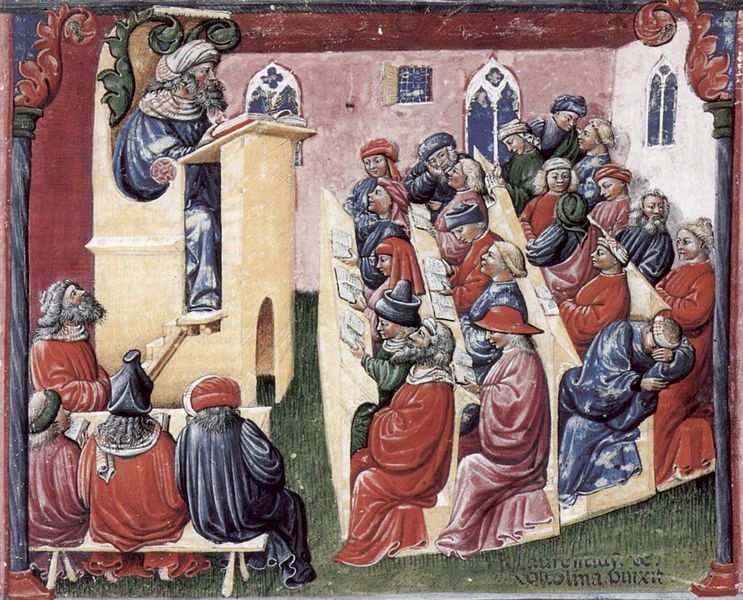
The University of Bologna developed gradually as groups of scholars came together in the pursuit of learning – namely for the study of Roman Law in the wake of the Investiture Contest. Resultantly, Bologna became renowned as a centre for legal education, with many students travelling far to be taught by leading experts in both canon and civil law at the studium generale – the Latin term for universities. The students of Bologna, who were older men, formed guilds, which meant the organisation of the university relied on its clientele. These men were initially responsible for hiring teachers and paying their salaries. As consumers paying for a service, students wanted to ensure they received the best service from their employees – the lecturers – and thus issued fines to ensure high-quality teaching. The oldest statutes of the university from 1252 include rulings on fining lecturers, and these orders were reinforced in the 1317 statutes for University of Jurists. Students only began to lose their power during the end of the thirteenth century, as salaried lectureships began to be paid by the commune, but this did not bring an end to the fining system.
Deposits
In anticipation of these penalties, lecturers were expected to pay a deposit. The 1252 statutes stated that teachers were obliged to deposit 25 pounds of Bologna before the 15th of September to cover any fines they may incur. Throughout the term, professors had to be cautious with their classes if they wanted to save their deposit. Lecturers were also prohibited from leaving Bologna for extended periods of time without the permission of their students. The statutes of 1317 stated that after receiving the permission of his students and the rectors of the university to leave the city – for no more than eight days – the master must deposit 100 pounds of Bolognese money or an object of an equal value. If he did not return in time, he would lose the deposit and have to appeal to the University to return.
Curricula, Puncta & Disputations
Lecturers were expected to cover parts of the curriculum within a fixed time – normally two weeks – during the academic year. Professors were not permitted to omit parts of these puncta, nor leave difficult parts of the text until the end of the class. These oversights could be disadvantageous. Without a basic understanding of their core texts and ample time to cover difficult material, students would be unable to participate effectively in disputations – the main form of examination in medieval universities. During disputations, students would be assigned one side of an argument and have to duel with their peer in academic combat. The content covered within lecturers were the foundation for these debates and ensured students could best their opponent. Professors were also responsible for arranging these debates throughout the year and could be fined if they did not fulfil this duty.
Tardiness & Overrunning
To cover the curricula, timing was of the essence. The university timetable was dictated by the daily services of the church, ensuring students and masters could attend mass. Masters were not allowed to start their lecturers before the bell at St. Peter’s finished ringing for the morning mass. However, they were expected to be in the vicinity of their classroom to ensure that the lecture started immediately after the bell. If the lecturer was not promptly on time, he could be fined nine Bolognese pounds. Professors were also forbidden from letting their classes overrun or be completed before tierce, or Third Hour, the church service held at 9 a.m.
The Ultramontanes & Cismontanes
With rules in place, the university needed people to monitor the indiscretions of the professors. From 1317, both the schools of civil and canon law were required to select two Ultramontanes – students from beyond the mountain, outside the Italian peninsula – and two Cismontanes – students from this side of the mountain, inside the Italian peninsula – to denounce the masters for their misdeeds. The introduction of these medieval hall monitors meant lecturers could not easily escape penalties.
Conclusion
Ultimately, the student guild model of the University of Bologna set the foundation for this type of fining system. Scholars were paying for a service and needed to ensure that they were getting their money’s worth – potential at the detriment of their professors. From the deposit at the start of the year to the bell at St. Peter’s, lecturers would have had the fining system constantly looming over their heads, making them worry if they would be left out of pocket for even the smallest mistake. Perhaps lecturers today should be thankful that they are only subjected to the termly feedback form, and not a harsher punishment for running five minutes late to class.
Elena Rossi is a second year DPhil candidate in History at Magdalen College, Oxford. Her research considers how women encountered worlds of learning in the university towns of Oxford, Paris and Bologna from c. 1270-1500. She is also the Peter Gosden Fellow for the History of Education Society and a Student Lead on the Medieval Student Experience Project at Queen Mary, University of London.
Sources
Alan B. Cobban, The Medieval Universities: their Development and Organization (London, 1971).
The Statutes of the University of Bologna, 1252, in D. Maffei, ‘Un trattato di Bonaccorso degli Elisei e i più antichi statuti dello Studio di Bologna nel manoscritto 22 della Robbins Collection’, Bulletin of Medieval Canon Law, 5 (1975), pp. 73-101 (pp. 93-6).
The Statutes of the University of Jurists at Bologna (1317-1347) in H. Wieruszowski, The Medieval University: Masters, Students, Learning (New York, 1966), pp. 169-172.