Alexa Rodríguez, University of Virginia
Almost two years later and school systems across the world continue to be disrupted by the COVID-19 pandemic. Yet, this is not the first-time schools have faced the challenge of operating during a public health crisis such as this one. A century ago, schools in the Dominican Republic also faced similar questions about whether to remain open or closed due to the surge in influenza cases during the US military occupation, 1916-1924.
Between 1918-1921, the department of education in the Dominican Republic faced staffing shortages, anti-vaccination propaganda, and the convergence of multiple health crises. In my research, I found that influenza and measles afflicted different areas, on varying timelines, causing some regions to reopen schools at the same time others were attempting to contain an outbreak. Azua, a region in the southwest part of the country, was struck first by measles then subsequently by the arrival of Spanish flu in the fall 1918, causing the schools in the urban center to shut down entirely.[1] In San Juan, also in the southwest, all schools were closed except for one because of public health concerns.[2] During the winter of 1919, the epidemics spread to the north and central regions of the country. In schools that remained opened, attendance plummeted, and inspectors, principals and teachers reported having trouble enforcing the compulsory school law.
I conducted this research just as my home in New York City became the epicenter of the COVID-19 pandemic during spring 2020. I remember feeling disoriented as I examined documents that were a hundred years old and yet so closely paralleled what was unfolding right before my eyes. As I heard people speak about students being absent from school, I read about how officials in the Dominican Republic alleged that the severe impact of these epidemics was further exacerbated by a trend toward opportunistic absence. One school inspector in Jarabacoa wrote to the municipal government claiming that families in rural communities—often relatively far away, in locations with which teachers were unfamiliar—chose to withhold their children from school under the “pretense that they are ill,” since teachers were unable to abandon their posts and could not properly confirm the cases.[3]
As I was inundated with news about the rising death toll in the city, I learned about the many families who suffered from the traumatic loss of a child or family member due to these rampant illnesses. One father described his struggles this way:
A family man as I am, fully aware of my duties, I have never allowed my children to stop fulfilling their duty to attend school. But today it is the case, Mr. Regional Superintendent, that their grandmother and their mother are both on their deathbed and the other seriously ill, to such an extent that I am forced to leave the town and go to Lopez in search of better means of achieving health, of the latter, and that the former is threatened with death because of the years.[4]
Looking back two years later, I realize how living through the pandemic and witnessing the devastating impact on my community grounded these stories and informed how I wrote about my research. Some of the places I read about were already familiar to me, as my family is from the Dominican Republic and we often traveled through these very cities and villages. Because of the pandemic, I thought a lot about what the historical actors were grappling with, how living during this period impacted their lives, and whether they were my relatives or if my family knew them. This proximity to the topic often made researching exhausting, as it took an immense emotional toll. Nonetheless, I also found these experiences strengthened the work, as it provided me with insights that I could not have obtained otherwise.
As we enter this critical juncture, where politicians seek ways to push us towards “living with the pandemic,” I urge us to continue to take a moment to capture these historic moments and the realities of living through these uncertain times. We do not know the impact they may have on future generations as they attempt to understand what the current moment was like.
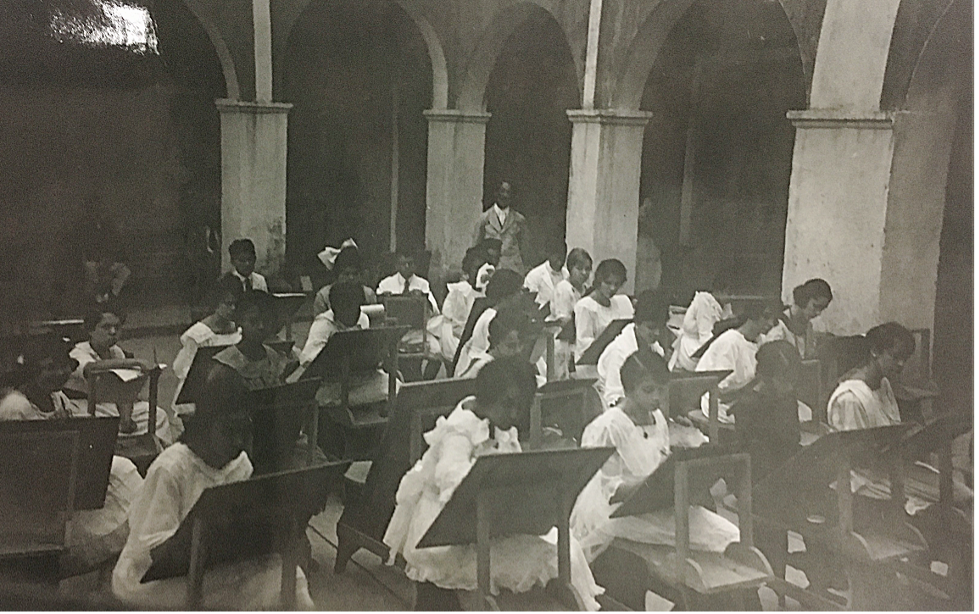
Photograph No. 30A-520316; “Children of the Dominican Republic in School, World War I,” WWI; General Photographic File, c. 1775-1941; Records of the United States Marine Corps; National Records Archive Administration-College Park.
Author Biography
Alexa Rodríguez, Ph.D. is a Mellon Postdoctoral Research Associate in the Center for Race and Public Education in the South at the University of Virginia and a Research Fellow in the Edmund W. Gordon Institute for Urban and Minority Education at Teachers College, Columbia University. Dr. Rodríguez’s research sits at the intersection of schools, migration, and the formation of racial and national identities in both Latin America and in the United States. Her dissertation, “‘For the Prosperity of the Nation’: Education and the US Occupation of the Dominican Republic,” uses historical methods to examine the 1916 US occupation of the Dominican Republic. Dr. Rodríguez is currently working on a book manuscript, Crafting Dominicanidad, a transnational and intellectual history that examines how Dominican stakeholders used public schools to articulate and circulate competing notions of Dominican citizenship during the early twentieth century.
[1] Letter from the regional superintendent of the southwestern department to the chief sanitation officer in the province of Azua, November 15, 1918, document no. 0264, exp. 1, 110410, Secretary of Justice and Public Instruction, Digitized Collection, Archivo General de la Nación (hereafter cited AGN); Letter from the regional superintendent of the southwestern department to the General Superintendent of Public Instruction, November 6, 1918, document no. 0266, exp. 1, 110410, Secretary of Justice and Public Instruction, Digitized Collection, AGN.
[2] Letter from the secretary of the regional superintendent of the southwestern department to the regional superintendent of the southwestern department, December 30, 1918, document 0080–0081, Dic, exp. 1, leg. 74, 110437, Secretary of Justice and Public Instruction, Digitized Collection, AGN; Letter from the regional superintendent of the southwestern department to the General Superintendent of Public Instruction, November 9, 1918, document no. 0168, exp. 1, leg. 74, 110437, Secretary of Justice and Public Instruction, Digitized Collection, AGN; Letter from the school inspector of San Juan to the regional superintendent of the southwestern department, November 26, 1918, document no. 0168, exp. 1, leg. 74, 110437, Secretary of Justice and Public Instruction, AGN.
[3] Memorandum from the school inspector of Jarabacoa to the municipal government in Jarabacoa, March 31, 1919, document no. 0992–0993, exp. 1, leg. C196, 104805, Secretary of Justice and Public Instruction, Digitized Collection, AGN.
[4] Letter from a parent in Santiago to the regional superintendent of the northern department, February 16, 1919, document no. 0266, exp. 2, leg. 1_683, 100729, Secretary of Justice and Public Instruction, Digitized Collection, AGN.