
Malcolm Tozer
Physical literacy, as applied to the physical education of children and the lifelong well-being of adults, has many advocates. The International Physical Literacy Association (IPLA) publishes a definition on its website and claims that the concept owes its creation to one of its members, Margaret Whitehead, in 1993.
“Physical literacy can be described as the motivation, confidence, physical competence, knowledge and understanding to value and take responsibility for engagement in physical activities for life.”
An internet search shows that other groups have rival definitions, but all share the IPLA’s woolliness – which probably explains why no major UK dictionary lists the term – and most accept the claim of Whitehead’s authorship. A little historical research, however, would have served the advocates well: one trail can be followed in England from 1905 to 1988.
Reginald Roper
Six colleges had been founded between 1885 and 1905 to train young women to become teachers of physical education for girls, but there were no colleges for men who wanted to teach boys. The women’s professional body, the Ling Physical Education Association, did, however, have one male member: Reginald Roper. He had trained at the Royal Central Gymnastic Institute in Stockholm, founded by Pehr Henrik Ling in 1813.
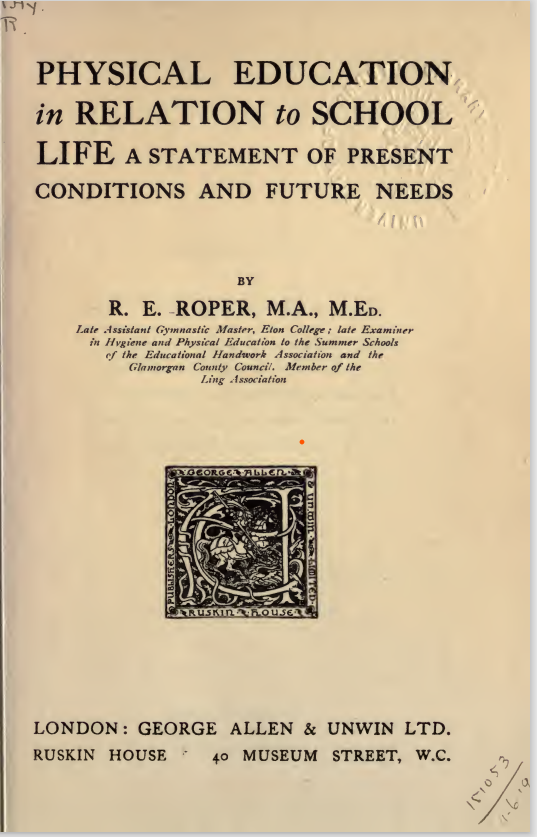
Roper taught at Eton College from 1907 and then moved in 1912 to Bedales School, a new co-educational boarding school, where he taught alongside a female colleague. He founded the men’s Physical Education Society (PES) in the same year, and in 1917 published Physical Education in Relation to School Life.
Secondary Schoolmasters’ Physical Education Association
Roper proposed a therapeutic and holistic role for physical education to counteract the impact of an industrial society, including poor conditions at home and at work, and he called for more men to be qualified to teach the subject. The PES, now the Secondary Schoolmasters’ Physical Education Association (SSPEA), worked with the Board of Education from 1924 until 1939 to provide short courses to train male teachers, and lobbied for a men’s college to run a two-year course to match the women’s training – all with support from school medical officers and teachers’ associations. Success came in 1933 with the founding of Carnegie College in Leeds.

Co-education of Mind and Body
Lawrence Jacks, principal of Manchester College, Oxford and a vice-president of the SSPEA, was a vocal advocate for the revival of the Greek concept of the whole man: he added ‘music’ to Roper’s ‘gymnastic’ to complete the Platonic ideal. He argued in The Education of the Whole Man that, with the demise of manual crafts, ‘skill hungry’ men and women were now ‘physical illiterates’. ‘We should regard the man, woman, or child whose has never been taught to control the body intelligently as cut off from the finer uses of which the body is capable and from the joys to which such finer uses lead, and still more to be pitied than the illiterate.’ ‘A co-education of mind and body’ through physical education was needed.
Physical Literacy
Physical literacy was the ability ‘to control the body intelligently’ from childhood through adulthood. The SSPEA’s courses and Carnegie’s training put theory into practice, and publications by Roper, Maurice Jacks, Gerald Hedley, Gerald Murray, Philip Smithells and Thorold Coade disseminated the message to all schools. After the Second World War, Davis Munrow and Peter McIntosh, both Carnegie graduates, imbedded the concept in Britain’s first degree course in physical education at the University of Birmingham. McIntosh took it onward when he was appointed senior inspector for the Inner London Education Authority (ILEA).

A Physically Literate Population
McIntosh’s ILEA report of 1988 on the state of physical education in London’s schools, ‘My Favourite Subject’, began with a statement: ‘The aim of Physical Education is to lay the foundations for a physically literate population, cultured in the sense of both having an understanding of physical activity, and experiencing enjoyment in it.’
The seven objectives were:
‘1. To encourage physically active life-styles.
2. To help children to understand sport.
3. The achievement of a sufficient level of skill to enable physical activities to be pursued in adult life.
4. An understanding of exercise and its relationship to fitness, health and wellbeing.
5. To stimulate optimum growth and development and to provide opportunities for the positive use of energy.
6. To use sport as a vehicle for social and moral improvement.
7. To give children both the capacity to participate in a range of activities and the ability to benefit from these activities.’
Roper, Jacks and the SSPEA would surely have applauded.
Extracted from ‘Reginald Roper and the Secondary Schoolmasters’ Physical Education Association: physical literacy for the whole man, 1905–1939’, Sport in History, 2022: https://www.tandfonline.com/doi/full/10.1080/17460263.2022.2066715
Malcolm Tozer taught at Uppingham School from 1966 until 1989. For six years from 1989 he was Northamptonshire Grammar School’s first Headmaster and then Headmaster of Wellow House School for a further ten years. Since retiring in 2004, he has led inspections for the Independent Schools Inspectorate, served as a governor at Repton School and Foremarke Hall, lectured at Buckingham University and promoted partnerships in physical education and sport between state and independent schools.