
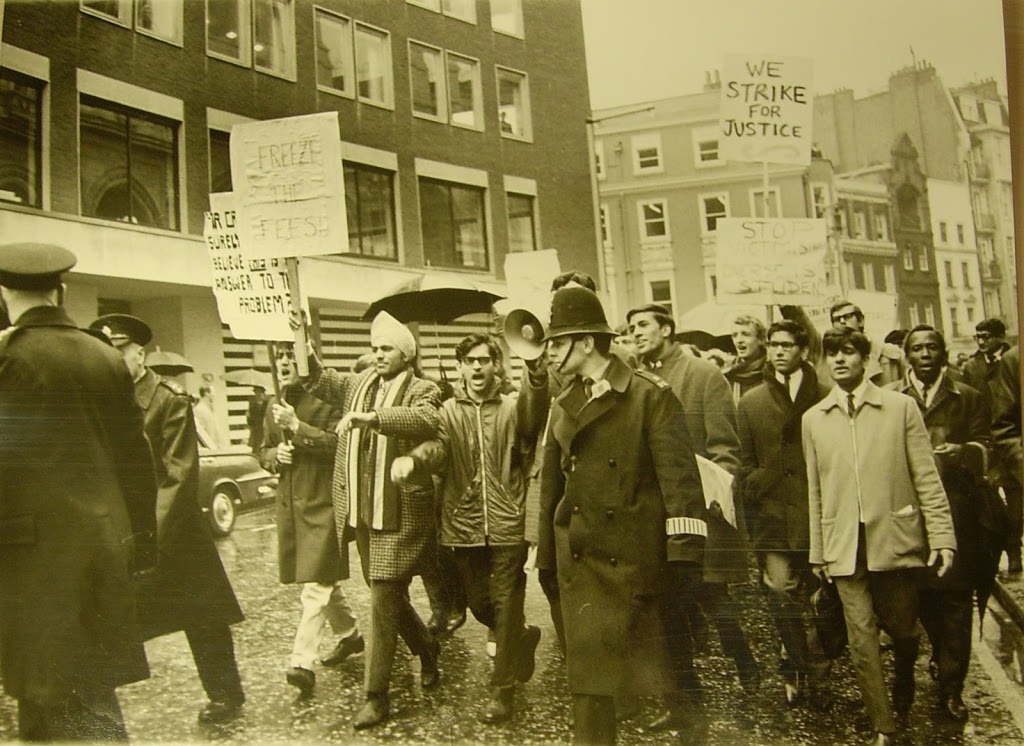
The half a million international students studying in the UK are heirs to a complex legacy of overseas students studying in Britain. From medieval scholars traveling between Oxford and Paris, medical students traveling to Edinburgh, Indian students coming over in the late 19th century, or Chinese students studying in London today – politics and education combine in these students studying away from home. One moment that is particularly important for international students occurred in 1966-67, when the British government began charging different fees for overseas students than for home students.
Today we discuss that change and the student protests that came with it. Our guide is Dr Jodi Burkett, social and cultural historian of late twentieth century Britain and a Senior Lecturer at the University of Portsmouth. Her research looks at the cultural and social impacts of the end of the British Empire, with a particular focus on national movements like the National Union of Students. Her recent chapter – Boundaries of Belonging: differential fees for overseas students, c. 1967 – touches on a number of important questions about race, national identity, and student politics and how these intersected with the overseas fee hike.
Episode Transcript
Michael Donnay
You’ve probably noticed from my accent that – although this podcast is produced by the UK history of education society – I myself am not British. Instead, like thousands of other students this year and throughout Britain’s history, I traveled over an ocean to study at a British university. You could say that I am an overseas student – although the term international is more in vogue these days.
There is a long history of overseas or foreign students studying at British universities, but today we’re going to look at the point when that distinction becomes really meaningful. In 1966, the British government announced that the fees for overseas students would – for the first time – be different from those for home students. This is the moment when it starts literally costing something to have that “foreign” or “international” label placed on you. Unsurprisingly, students were not happy about the prospect of suddenly paying substantially more money and – given that it’s the 1960s – protests sprung up in response.
Our guide through this complicated moment today is going to be Dr Jodi Burkett. She is a social and cultural historian of late twentieth century Britain and a Senior Lecturer at the University of Portsmouth. Her research looks at the cultural and social impacts of the end of the British Empire, with a particular focus on national movements like the National Union of Students. One of her recent contributions on the topic is a chapter in The break-up of Greater Britain, which examines this moment in the 1960s when overseas students started paying higher fees at UK universities.
Jodi’s chapter – Boundaries of Belonging: differential fees for overseas students, c. 1967 – touches on a number of important questions about race, national identity, and student politics. We touch on many of those topics in our conversation today. I really appreciated speaking with Jodi. As an international student myself, it helped put the current state of affairs into a richer historical context. And I think it also provides a window into wider conversations about Britain’s place in the world today.
Before we jump in, a quick note about the audio for today’s episode. Jodi was joined by her lovely canine companions for some of the recording, so you might hear them in the background sometimes. They were excited to talk student politics and – since I’m sure you are too – let’s jump in.
Welcome Jodi, thank you so much for taking the time to join us today. I’m really excited for our conversation.
Jodi Burkett
I’m really happy to be here.
Michael Donnay
Your focus on the National Union of Students is one of the parts of the chapter that I found the most interesting, particularly because you point to a lot of the sort of internal politics and structure of the organization as being one of the main reasons why it addresses this question in the way it does. I was wondering if you could talk just a little bit about how the organization is set up and run at this point? What does student politics and student activism look like? And then how is that impacting their response to the fee hikes?
Jodi Burkett
I want to start actually, with talking a little bit about 1968 if that’s okay, because actually, student politics is often linked to mostly ’68 looms really large in student politics. And I think one of the reasons I started looking at student politics is I was sort of expecting there to be quite a lot of activity in ’68. And what I actually found was quite a problematic situation for Britain. So in in historiography of 1968, Britain doesn’t loom very large at all. There’s either, you know, a page about Britain or a paragraph at some point sometimes. And partly that is because of the character of the National Union of Students at this time. So one of the interesting things is that the National Union of Students’ constitution in the late 60s, contained a clause – Clause Three – which meant that they, they said specifically, they didn’t want to become a political debating forum. So that they were only allowed to talk about things that affected students, because they were students. So this is usually referred to as the “students as such” clause.
So you know, for example, they talked about apartheid, but they could only talk about apartheid in education. They couldn’t talk about the system of apartheid. And this was a huge area of contention within the NUS through the 1960s. So you can see – they have fantastic verbatim minutes of their conferences twice a year, which are a wonderful historical source. But you can see within them every single conference, they debate this part of the constitution through the late 60s. And it finally they finally managed to change it at the end of ’68. So the National Union of Students was not involved in any student protests in ‘8, because they weren’t allowed to be really. There were obviously local students who were. So there was citizens and those kinds of things at universities, but the NUS itself wasn’t allowed to be involved. And this changed really from ’69.
So in ’69 you see the NUS changed significantly in character. It really becomes a campaigning organization after ’69 with its new president Jack Straw. So he sort of takes NUS in that – into the new direction of being able to actually have a political voice. But what you see in the late ’60s then is when this is debate is going on, some people are really working within the NUS to try to change it. And some people are deciding to abandon the NUS and set up their own organizations. So you see some new organizations being created. Probably the biggest one is the Revolutionary Socialist Student Federation, the RSSF. And it started in sort of late ’66, early ’67. And interestingly, one of its first issues that it takes up is the overseas student fee hike. So they take up this issue as – as both a place to have their own voice, but also a way to really undermine or criticize the NUS. And so they use the issue of overseas student fees to highlight what they see as a lack of commitment by the NUS or an inability to affect real change. So they use this issue to try and encourage students to either leave the NUS or to push it to becoming more of a political organization. So the overseas student fees kind of gets caught up in that debate about what the role of a student movement should be, what the role of the organization should be, and what they should be doing – their place in British society more broadly.
Michael Donnay
And in terms of sort of how that shakes out – my sense is that students broadly are not supportive of this change. But it seems like there’s different reasons for that. And in particular, you point to the conservative student organization, which – coming from an American context, I was just kind of shocked to see any resistance coming from that corner. So I was wondering if you could explain a bit how that fits in with those broader bit of student politics, and maybe national politics more broadly at that time?
Jodi Burkett
Yeah. So I think one of the things that we often forget is that there are actually important conservative student organizations. And we see certainly through the 70s, that you Federation of Conservative Students become much more popular and larger and have more of a voice. But in this debate, really, conservative students follow the Conservative party line. All of this is taking place under a Labour government. So it’s a Labour government that is bringing in this this rule or the new tuition fees. So the Conservative Party is against that just on principle, because something that’s Labour is doing. But sort of more fundamentally, they see this as a recognition that Britain doesn’t have that important imperial rule anymore. So a lot of Conservatives are still quite imperial minded. They want Britain – if they’re not going to be a formal empire – than they want them to be at the heart at the head of the Commonwealth. They want to keep soft imperial things going and they see education of overseas students is a really important way to to keep Britain’s international and imperial position. So conservative students follow those kinds of lines as well. They advocate that that overseas students should be able to come here because then they’ll then they’ll set up businesses, they’ll network with us, they’ll continue to buy British goods, they’ll, you know, keep this sort of soft imperial power going. So it’s seen as more of an opposition to Britain becoming smaller, diminished in some way. It’s a way to keep that great power status in one form or another.
Michael Donnay
Yeah. Were there any students who were supportive of this? Is there any records of students who think that this is a good move for the government to be making?
Jodi Burkett
Yes. And some of those are conservatives as well. So it’s not all conservatives that see this as a problem. But yes, there are definitely some students who said, “Absolutely, the government should be doing this because mostly because these students don’t pay their parents don’t pay taxes. So why should we be subsidizing them?” So lots of the arguments for this, and the government’s own arguments for this policy, are very fiscal minded.
So the Robins Report 1963, it’s a very important sort of moment in higher education policy. And it’s in this document, actually, that for the first time the government starts talking about educating overseas students as providing a subsidy for them. And so the language changes. So it’s the introduction of fees, then is reducing the subsidy rather than anything else. So that the people who are who support the policy are are all about, you know, trying to save Britain money. And there’s also arguments as well that overseas students quite rightly are not poor. Most of them, they’re quite well off. You know, it’s quite an elite thing to come to Britain to be a student. And so most of these students could pay for an increase. The government’s argument as well is that a lot of these students are funded by the government. So the British Council pays for a lot of these – so they won’t even notice. So what’s the problem? So it’s partly about shifting the money to another organization. But yeah, there are some students who who certainly do approve of this, because they see it as a sound fiscal policy.
Michael Donnay
And I think something you pointed to there about, you know, these students largely being wealthy or there being an a sort of elite status involved in coming to the UK to study speaks to this idea of sort of changing racialization of overseas students. And particularly the way that student activists are talking about the fees is actually contributing to a sort of “more racialization” or different racialization of overseas students that had existed previously. And so I was kind of curious how you see that transition happening? What does the racialization of overseas students look like before this moment? And how does this transition into what might be a different way of looking at those students?
Jodi Burkett
Yeah, I think this is one of the most important but also one of the most complicated aspects of what’s going on. So discussions about race, I think, are really prominent in 60s Britain. And how they get muddled up really, with overseas students, and the politics of that is quite interesting. So I think before this, what we tend to see is it you know, so colonial students are understood as Black and poor. Not necessarily rightly so, but colonial students are, are racialized as in that way. Whereas other students are either not considered overseas or foreign in that sort of way – or foreign students are not problematic in that kind of way. So I think what is happening is the lumping together everyone of as overseas and the way that then overseas students are sort of automatically assumed to be Black and poor or from Africa or from Asia. It’s the ways in which those conversations are happening in the public that automatically link overseas and, and Black and poor. That is, I think, the process of racialization, that’s taking place. So I’m trying to unpick there is is how the public discourses about that are actually happening.
I think one of the things we need to remember, first of all, you know, overseas students, as I said, are tend to be quite wealthy. They often have to do checks of their financials before they’re allowed to come. So you know, there’s a real sense that this is an elite endeavor. We also need to remember that, I think, in the late 60s, probably 40% of students are coming from, or of the top eight countries that are sending students 40% of them are coming from the US, Canada, and Norway. Just to back up a little bit, we don’t actually have any records of the skin color or the race of overseas students. A lot of this is based on countries of origin and that was at the time, how they were discussing it. But it’s also the only data that we have is where the country’s students are coming from it. By and large students coming from the US, Canada and Norway would be predominantly white. And they make up about 40%, of those top eight sending countries. So when we talk about overseas students is automatically poor and Black, we ignore that whole section, which is in its own ways problematic.
But I think, more importantly, as we see that racialization continue in the 70s, we ignore completely the experience of Black British students. And I think what is really doing is, is continuing and setting up that dichotomy between “home white” or “home, British, white” and foreign Black other. And I think that’s what’s really quite problematic. And certainly some of the stuff – the work I’ve done on the later 70s – there are very clear examples of Black British students who then join overseas student organizations. They’re not overseas students, but there are that’s where race is being discussed. That’s where anti-racism is happening. So they, that connection of overseas and blackness, becomes useful in some ways, and also highly problematic in others. So that’s what I was trying to unpick is how those debates, on automatically assuming that overseas students are poor and Black becomes a problematic issue.
Michael Donnay
That’s really fascinating. I’d love to turn now the bigger picture, how this fits in with these broader ideas of Britain’s place in a decolonizing world. And particularly, you talk about this shift – which I think you’ve discussed a little bit, but was wondering if we could dig into it a bit more deeply – of this view is Britain from sort of a mother country that has an empire to which it is in some ways responsible, even if those ways can be a bit problematic, to having a development relationship with the Commonwealth where it provides aid and development assistance, but doesn’t necessarily have quite the same set of responsibilities. And I was wondering if you could explain that dichotomy and particularly how you see that playing out in the language being used in this discussion?
Jodi Burkett
Yeah. There is some some really good historiography. I think it’s J.M. Lee, who really talks about – he says this is when Britain shed the role of mother country. He’s talking about, you know, that the move from a sort of paternalist parental looking after, as they saw their children, the children of empire to be more more of a sibling, perhaps been a parent, that kind of relationship. So he talks about that, that mother country role being shed. And Sarah Stockwell as well, as she picks the 60s as that that decade when the Commonwealth becomes about development. And I mean, certainly the empire in the late in the 30s and 40s is really about sort of development. And 50s, for sure. But it’s with the independence of most of these countries through the 1960s. It’s that shift of trying to figure out how to carry on these relationships. There is obviously a relationship there, it makes sense for there to be a connection because of language. But yeah, that sort of shift I think we see it in the this debate, the discussion. You can sort of see people working out that, you know, “we feel responsible, but are we responsible? And what does that actually mean?” How people talk about different kinds of students.
So Nicholas Tarling, I think I mentioned as well he talks about how we see that relationship based on where students are coming from. So if they’re coming from a developed world, the British government had quite a different attitude towards them if they saw it more as an educational exchange, rather than sort of looking after people. And, you know, certainly when I was doing the research, I was quite struck by how the discussion really ended up being about foreign aid. And so there are lots of people within the House of Commons who criticize the government for bringing this policy in saying that this was just another sort of backdoor way for them to cut aid spending. And certainly the government had been cutting aid spending, that’s one of the things they were doing. There was, you know, some fiscal problems going on. So they were looking for ways to cut, cut expenditure and aid is one of them. So very quickly, the discussions about overseas students, education became really about this is this is one of the best ways that we have a foreign aid. And you can see, I think some of the problematic discussions about aid creep in there as well. So one of the arguments was that this is one of the best forms of foreign aid because it can’t be squandered. So it brings up all those issues about – they were concerned about giving money to what they saw as corrupt government. And if they could just bring over these young men, educate them properly, so that they were inculcated into sort of British ways of doing things, and send them back then that would be a much better way to keep connections with these countries, but also bring them up to British standards.
Michael Donnay
It was kind of surprising to me to see this be part of the foreign aid conversation. Is that something – is that a new way of understanding overseas students at this time? Or is that more of a long standing tradition to think about aid. Because I was particularly struck by the comment that it’s an “underappreciated” version of aid – that the countries don’t appreciate how much money we’re spending on their students. And so part of the fee hike is sort of to make them recognize the true cost and how much we are actually giving an aid. But at least for me, I never sort of never thought about that as a form of foreign aid.
Jodi Burkett
I was surprised by it to actually. It was really interesting how the discussions about you know, how these countries should be really grateful, comes very quickly into. Partly this is a great way to give aid, because then we can direct exactly what is happening and how it works. But also, we need to highlight this to other countries to show how much we’re spending on their students. And I think it’s controversial, because I certainly don’t get the impression that a lot of these countries sending their students to Britain perceive it in this way. So that becomes a bone of contention. Certainly, ambassadors and sort of officials from these countries are not receptive to that language at all. And certainly a lot of them and certainly a lot of the students later onsee it not as aid but as a form of reparations in a way. And I think that’s also quite interesting in that they see this as Britain’s responsibility to educate the students partly because being part of the empire is why they don’t have their own universities to go to. They see it as a way that Britain needs to make amends for what they’ve done, rather than be magnanimous and give us this gift. So that there is a real tension there, I think.
Michael Donnay
I would love to talk a bit about sources. And particularly because you’ve worked over vastly with those students sources. I was wondering if you could talk a bit about the source base you’re working with. And then what the challenges or opportunities with working with those sources might be?
Jodi Burkett
Yeah. So I mean, student newspapers is largely what I’ve been working with, and they’re fantastic. But they are challenging for sure. So we’ve we’ve certainly seen in the last sort of, around a decade or, so a number of universities are have digitized their student newspapers, which is fantastic. So we’ve got, I think, six or seven universities that have digitized, and it’s particularly the postwar period. So I think some of the earliest are probably the Imperial College, London’s Felix starts in ’49, I think. But a lot of them start in the 60s. So that’s fantastic. I think student newspapers are, are a wonderful source, they give us access to student voices in a way that we hadn’t really had before.
So previously, if you wanted to look at students, you, most discussions of overseas students talk about government policies, or what’s in the national press and those kinds of things. So looking at student newspapers gives us a much better insight into what’s actually happening on campuses. Now that they are obviously quite problematic. Also, in some ways, it is very much a self selecting group. So the people who are involved in student newspapers are very active students. So that gives us a particular type of student, it’s not the norm by any stretch. They tend to get more and more professional as the decades go on. But they are certainly in the 60s, somewhat hit or miss about the kind of information they give you. Sometimes they let you know who the editorial board is. Sometimes they don’t. Most of the time they don’t have authors for the the articles, so you don’t know who exactly is writing it. You don’t necessarily know what that author’s background is, particularly. Some of the newspapers are obviously the voice of the Student Union. And some are very much independent of the Student Union. So sometimes they’re funded by the Student Union. Sometimes they tow the Student Union line, sometimes they do not. So there’s, there’s all of that sort of stuff going on.
And I think as well, one of the issues with the digitization, although it’s fantastic, it is all universities and quite wealthy universities that have had the time and the space to digitize their newspapers. So that tends to skew things in a particular way. So whereas you know, a few years ago, it was only The Times that was digitized. So everyone was using The Times, I think it’s similar sort of thing happens with with student newspapers. So I think one of the things that I’m particularly keen to point out is that higher education is not just universities, certainly in the 60s and more so even in the 70s, the highest growth in higher education is actually in polytechnics. And certainly, for overseas students, if you look at numbers, as many overseas students are going to polytechnics and technical colleges as they are going to universities. So one of the things is that we don’t have really any student newspapers digitized from former poly’s or post-92 institutions. The only possible example or exception, there is the lead student, which in 1970, I think, joins up and as becomes the newspaper for both the university and the poly. So this is the first time you get sort of a poly-student perspective. So it does tend to skew our understanding of the students towards the wealthier, more research intensive end. So there are I mean, certainly some caveats to using them. But again, I think they’re a fantastic source.
Michael Donnay
We’ve talked big picture that overseas students are the site for a lot of these anxieties about Britain’s place in the world, about race and immigration. And I’m sure that played out sort of in their day-to-day lives and their experience of being and studying in the UK, and was just wondering if there were any stories you would come across, or descriptions of their experience that had really stuck with you?
Jodi Burkett
So actually getting the voice of overseas students is somewhat challenging. So the student newspapers give you some hints of that every now and then there’s an article that’s penned. Often it’s credited as being by, you know, an overseas student group rather than an individual. So, you know, we don’t necessarily get that. But there’s, there’s obviously a few examples. There’s more examples from the 70s than there is from the 60s, and more examples, possibly from the 50s as well.
One of the caveats is, all of this is from overseas students who are Black. So we don’t really have the voice of overseas students who “pass” as home students in that way. So I think that’s one thing to keep in mind. But all of these students talk about discrimination. They were, you know, subjected to significant racial discrimination on and off campus. So that is I think is something quite important. Certainly we see in NUS conference records, that they were anti racist, but also that they’re blind to their own their own assumptions about Black students in particular. So there were there was lots of concern in the 50s. And lots of examples actually, of overseas students becoming radicalized by being here. Hakim Adi’s book, which is quite interesting about West African students in Britain – he only goes up to 1960, so his examples are earlier. Certainly he talks about how they didn’t realize that they were colonial until they got here.
And, you know, we get lots of examples of overseas students – I think especially because they come from these wealthy privileged backgrounds, that’s kind of the treatment they’re used to has been elite. And then they come to Britain and are treated really badly. And that really changes their sense of what the empire is like, what Britain is like and what their place is within it. Now, one of the persons I interviewed was a man, he’s a professor now at a medical school in Manchester. Professor Aneez Esmail. And he was the president of the Overseas Student Bureau at Sheffield in the late 1970s. But he wasn’t an overseas student. And I think that’s one of our interesting examples. So he was a Black student. He was from Kenya. So he came over as part of the Kenyan-Asian crisis, if you want to call it that, but he was Kenyan-Asian, he came over with his family. But because he lived here for a number of years, when he started university, he wasn’t an overseas student. But he talks a lot about how he perceived the government’s treatment of overseas students as unfair. And how much he that shaped his understanding his anti-imperial understanding, and his understanding of race in Britain in the 70s. So yeah, there are some examples of overseas students talking about their own experiences, but they are largely dominated by stories of discrimination.
Discrimination in housing was a particularly problematic one. That is true in the 60s of all immigrants, Irish and Black immigrants. But there’s lots of stories of landladies in particular, not accepting overseas students or Black students. And the NUS did have particular policies about that – they actively would strike off landladies if they were racist, but that was certainly a predominant aspect of their story. I think, in terms of the examples of the stories of overseas students themselves, there is definitely a sense that being an overseas student shaped their understanding of the world, and more…I don’t know of any examples where it, it made them less anti Imperial. Certainly it if anything, all of the examples are about becoming more radical, more anti-imperial, more anti-racist, because of kind of that milieu. We do of course, have examples of overseas students being killed in London. There were two killed in the late 1970s. Around the same time as the murder of [Gurdip Singh] Chaggar in ’76? I think. So there are these examples as well of quite clear, violent discrimination.
Michael Donnay
That’s sort of a great lead into my final question, which is just in reflecting on how this research intersects with the history of education, but obviously, with so many other histories: are there things that you’ve learned or taken from this experience that will sort of inform how you think about your work? I’m thinking about that exact lesson that there the relationship to overseas students and broader activism movements is really central. Are there other reflections from this work that have really stuck with you in that regard?
Jodi Burkett
I think really the demand, the need to see a lot of this really local stuff actually being part of transnational conversations. I think that’s the thing that it’s really highlighted to me. To always remember that overseas students are coming from somewhere, they come with an understanding of the world. And they they shape the situation that they find themselves in as well. So there’s no way of knowing what…how student activism would have developed without this international flow of students. So yeah, I think that the need, the requirement to see national and local politics as actually being part of these international networks and transnational conversations about all manner of things.
You know from Black Power – certainly you know, you see all these discussions within NUS politics about about Iran and Iraq in the late 70s. Because there were Iranian and Iraqi students, they’re talking so having these conversations about these conflicts, many hundreds of miles away or 1000s of miles away, but they’re played out in these local places because we have diasporas connecting in that way. So yeah, I think that is one of the main things that I keep being forced to do. It’s so much easier to do national or local history, but to actually have to remember diasporas, to have to think of the broader questions: where are the students coming from? What kinds of things that they experienced already? It becomes much more complicated, but I think a much deeper, much more nuanced picture of the situation that we find ourselves in.
Michael Donnay
That’s a really fabulous place to leave it. Thank you so much for taking the time to chat with me today. It’s been amazing to learn more about your research, and I really appreciate you taking the time to speak with us.
Jodi Burkett
Thanks. It’s great to be here.
Michael Donnay
Passing Notes is a production of the History of Education Society UK. Our social media manager is Elena Rossi, and our executive producer is Heather Ellis. This episode was written and produced by me Michael Donnay. You can find a transcript of this episode, as well as more information about our events, publications and conferences at our website, historyofeducation.org.uk.
Sources
Boundaries of Belonging: differential fees for overseas students, c. 1967 in The break-up of Greater Britain by Jodi Burkett
Revolutionary vanguard or agent provocateur: students and the far left on English university campuses c.1970–90 by Jodi Burkett