
Ailsa Maxwell, Keble College, Oxford
The British are well known for their love of tea. In fact, over 100,000,000 cups are drunk in the United Kingdom every single day of the year. Children have always been a part of this culture. For example, it was estimated that 55% of four-year-olds drank tea with their meals in 1950.[1] Was the eighteenth century any different, and what can an assessment of this culture tell us about children’s education in polite society?
Origins of Children as Tea-Drinkers
Tea drinking culture was one of the most significant developments across all sectors of eighteenth-century Britain. This commodity permeated the lives of even the poorest Britons, accompanied by transformations not only in tableware and drinking receptacles but also daily routine. Taking tea was now a formalised part of the day, something which did not escape the notice or lives of children.
Daily Accounts
On Saturday 8th March 1788, fifteen-year-old William Hugh Burgess records in his diary ‘I did not go out all day, dined & drank tea at home’. A week in December gives a little more information as some people visited the Burgesses for tea, on Friday the 19th William wrote ‘Mr Cary drank tea here, we played cards and I lost’.In February the following year, he remarked ‘Jack and me dined, soon we went to see the man hang in chains. Papa and Mama drank tea at Mr Records’.[2]It is quite amusing in this example to see where William’s priorities lie. In fact, almost every diary entry over the course of three years discusses the taking of tea. Unfortunately, most children’s voices are prone to fade into historical obscurity due to a lack of source material. Luckily however, William’s entire diary from the ages of fifteen to eighteen has survived. William, or perhaps more likely his parents, were acutely aware of their social status and wished for him to climb the rungs of the social ladder. Educating him to be a polite gentleman who took tea, was one way to achieve this.
Children’s Tableware
The tableware used for tea drinking had its own importance. Children’s tableware became a booming market in late-eighteenth-century Britain. Although not many children’s cups survive, the relics we have illustrate a form of subtle yet continuous schooling. Teacups with religious, moralistic, and educational messages were commonplace, and even messages of praise for good behaviour were well-liked as they served as an embodiment of parental love and affection.
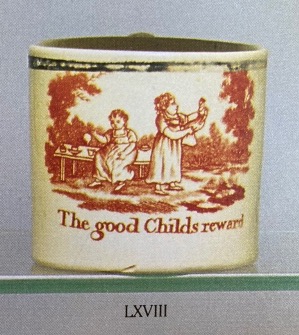
2 ¼ ins. ht.; 2 ½ ins. diam. No mark.
Pictured in Noël Riley, Gifts for Good Children: The History of Children’s China. Part 1: 1790-1890 (Somerset: 1991), p.24 and p.93
Playthings also began to replicate objects found in everyday life. Eighteenth-century tea sets were quite elaborate and rather different from the likes of Fisher-Price today. The sets regularly contained not only the expected components of teacups, teapots, coffee cups and perhaps a milk jug or a sugar bowl, but in fact entire dinner sets with gravy boats, vegetable bowls, dinner plates, dessert plates and even soup bowls and soup tureens.[3] These types of tea services were either made as doll house miniatures or were larger (approximately 6-8cm tall for teapots) and intended for actual play by children, usually young girls. By the ages of four or five, playthings began to be gendered and generally concerned cooking and sewing for girls.[4] William was apprised of tea etiquette whereas girls were often tasked with being the hostess. The tea sets were often ceramic, the most popular earthenware material of the period, but were sometimes porcelain which attracted a wealthier customer base and were even sold in London toy shops.
Conclusion
As the nineteenth century dawned, the tea table represented something much larger than itself. It demonstrated a ‘nuclear family consisting of mother, father, and children tak[ing] their places around the table and perform[ing] their respective tasks’.[5] Children were embedded in the flourishing culture of British tea drinkers, expected not only to partake in an afternoon cup but also spend their playtime with associated paraphernalia.
Children were engaged tea drinkers from the eighteenth century onwards. William Burgess’s diary illustrates his education from childhood to manhood through polite tea drinking culture while the boom in children’s tableware, especially toy tea sets for young girls, demonstrates the moulding of the middling-class eighteenth-century girl. Even times of supposed rest became opportunities for educating children.
Ailsa Maxwell is a second-year History DPhil candidate at the University of Oxford. Her doctoral research looks at what made ‘luxurious cuisine’ in eighteenth-century Britain, and she is examining the growing, importing, preparing and eating of foods within a cultural context to see how moral and social debates affected ideas about food, consumption, and body image in the period. She previously studied at London School of Economics (BA, 2019) and then University College London (MA, 2020).
[1] Jane Symons, ‘Mum, is it time for tea? New research suggests tea is healthier than modern drinks’ (3 December 2013) (retrieved from https://www.express.co.uk/life-style/health/446493/Mum-is-it-time-for-tea-New-research-suggests-tea-was-healthier-than-modern-drinks) and www.tea.co.uk.
[2] William Hugh Burgess, Diary labelled ‘Tom 1’, January 1788-June 1789, London Metropolitan Archives, F/WHB/001.
[3] Donna R. Barnes, ‘Play in Historical and Cross-Cultural Contexts’, Doris Fromberg and Doris Bergen, Play from Birth to Twelve: Contexts, Perspectives and Meanings (London, 2006), p.253.
[4] Naomi J. Miller and Naomi Yavneh, Gender and Early Modern Constructions of Childhood, (Cornwall, 2011), p.7.
[5] Julie E. Fromer, Necessary Luxury: Tea in Victorian England, (Ohio, 2008), p.19.